<- Back
Comments (47)
- andyjohnson0An interesting book on the subject of telegraph networks is The Victorian Internet by Tom Standage [1]. As well as the technical and commercial drivers, it also describes how the telegraph forced people to confront concepts like simultaneity, information being distinct from its physical medium, privacy, early approaches to encryption, etc. A fascinating book.[1] https://en.wikipedia.org/wiki/The_Victorian_Internet
- pchristensenI always have to recommend Mother Earth, Mother Board by Neal Stephenson[1] if the thought of undersea cables sounds at all interesting. I'll also second andyjohnson0's recommendation of The Victorian Internet[2] - it blew my mind how much of modern digital culture existed on telegraphs prior to voice.[1] https://www.wired.com/1996/12/ffglass/[2] https://news.ycombinator.com/item?id=46433901
- neillyonsWhen visiting Ayers Rock in Australia I stayed in Alice Springs. While I was there I learnt that Alice Springs exists because it was a repeater station for a telegraph line that stretched from Southern Australia all the way to London. There would be people listening to morse code, and tapping it out again to the next repeater station. Blew my mind that there was a wire that went all the way to London from Australia!
- teleforceFun facts, the subsea telegraph network cables coating were made from Gutta Percha [1].Unlike normal rubber, it is a type of thermoplastic and it's a popular organic plastic before the petroleum based modern plastic become pervasive [2].[1] The legacy of undersea cables:https://blog.sciencemuseumgroup.org.uk/the-legacy-of-underse...[2] Gutta-percha:https://en.wikipedia.org/wiki/Gutta-percha
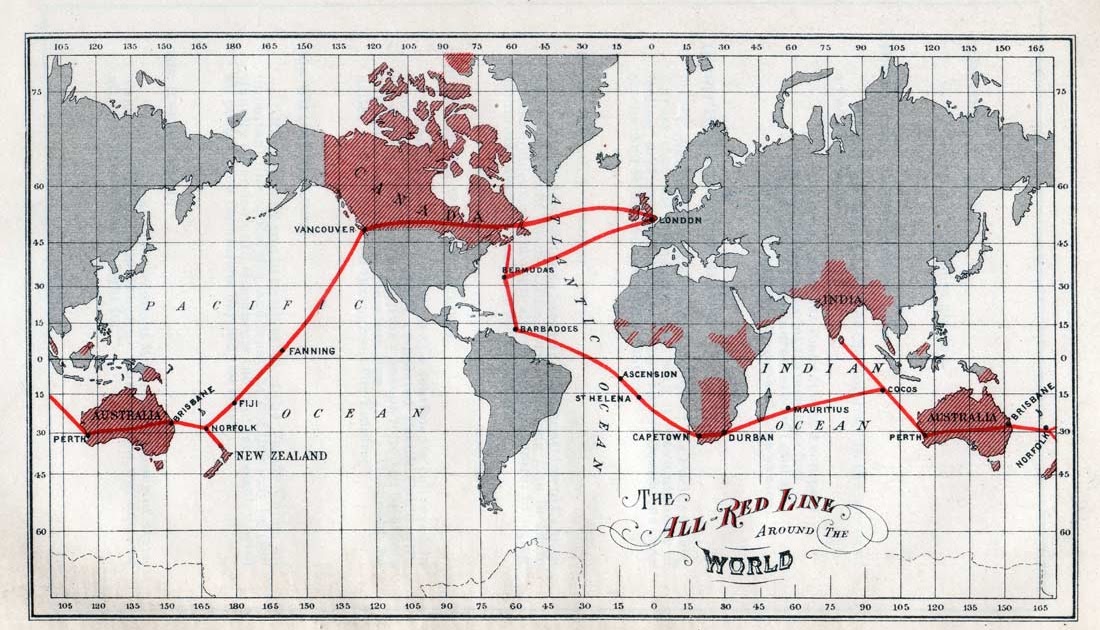
- jphowardHere is some more information: https://en.wikipedia.org/wiki/All_Red_LineAnd one of the old cable huts still exists: https://en.wikipedia.org/wiki/Pacific_Cable_Station
- KineticLensmanIt was strategically important in WW1 because the British could communicate with the colonies with very chance little chance of messages being intercepted. The Germans, in contrast, didn't have access to their own transatlantic channels and had to use plain-text messages on cables that the UK/US controlled (US operators disallowed coded comms).
- Alive-in-2025I love stories like this! Neil Stephenson has a great wired magazine article about information technology of that time, and telegraphs. The article is kind of a precursor to the ideas in his excellent book cryptonomicon. You should stop what you are doing and read that wired article. And then cryptonomicon if you haven't already done it. Best book to read over the rest of our holidays.Article in paywall at https://www.wired.com/1996/12/ffglass/The book and the article are fascinating explorations of the impact of technology and cryptography on the world. The people who did the work to invent and build these worldwide systems were just like us (hackers, inventors, technologists), and we are just like them in a way. We all stand on the shoulders of giants.Also I can't believe that article is 30 years old, boy I'm old.
- utopiahThe Cable that Changed the World (2024) is pretty nice on the topic. Shows us how, again, most of the things we consider "new" or at even revolutionary most showcase how historical ignorance.
- mjleeIf you enjoy this, you might like to read about the Zimmermann Telegram - British SIGINT that took advantage of this network, bringing the USA in to World War I.https://en.wikipedia.org/wiki/Zimmermann_telegram
- girishsoImagine people in 1890s or so, hearing about this almost instant transfer of messages, news to any part of the world - would be nothing short of magical modern technology.
- anonundefined
- thijsonSeeing the telegraph cross Canada like that reminded me of the network of hotels across Canada that were used by the wealthy on their way to the Orient from Europe during a bygone era.
- nephihahaThe original internet, more or less. Apparently whales liked to scratch themselves on some of the cables though.
- alexjf12here's an interesting series of videos on undersea cables, as described by... Tool Time from Home Improvementhttps://youtu.be/zmyBSrQodnI?si=OpFZhiQeNn3ax58p
- hakkikonuin this context: https://www.submarinecablemap.com/
- jimmySixDOF... an era bookmarked at the end by the first live music broadcast transatlantic performance of Old Man River from a studio in NYC to a theater in London and that wasn't until 1957 and is a story all on its ownhttps://www.sciencemuseum.org.uk/objects-and-stories/robeson...
- petesergeantIs the latency the same now as it was for the signal itself? Obviously the throughput is rather different.