<- Back
Comments (70)
- AnimatsThe power of money.I spent some time on legged locomotion back in the 1990s. It was clear then that you wanted torque control, and I did some work on the theory for that, trying to solve it from first principles, not machine learning. Got some nice theory and a patent out. But the parts just weren't there to build such things. As the article points out, the key to this is motor back-drivability. The final drive has to survive shock loads, and it has to dump forces into the motor, where the magnetic fields can take it. As I've quoted before, "you cannot strip the teeth of a magnetic field", a comment from early General Electric locomotive sales. (Locomotives are Diesel-electric, not Diesel with a clutch and shifting gearbox, because the clutch required is huge. Yes, it's been tried.) That's something few areas of engineering cared about, with the exception of aircraft flight control systems with mechanical backup.Pneumatic actuators looked promising, but proportional dynamic valves were big, heavy, and about $1000 each. Linear motors (not ball screws) looked like the coming thing back then, as 10:1 power/weight ratio had been achieved. But that technology never got much further, and Aura, the biggest player, collapsed in a financial scandal. Series elastic actuators were (and still are) a race between the spring compressing and the ball screw motor starting up. Hydraulics were too clunky; Boston Dynamics built a 400 pound mule, but the Diesel power pack never worked. Direct drive pancake motors were used by some SCARA industrial robots, but those were too big for leg joints. I thought someone would crack the direct drive problem eventually, but nobody ever did. We're still stuck with some gear reduction.Some of the exotic ideas for muscles mentioned in this article go back that far. The McKinney muscle is old, and not too useful. There was some interest in electrorheological fluids, fluids whose mechanical properties change when an electric field is applied. That didn't become useful either. Shape-memory alloys were a dead end; liquid cooling can overcome the slowness problem, but not the inefficiency problem. Everybody went back to good old electric motors, although they became 3-phase AC instead of DC. It helped that the drone industry made 3-phase motors and their controllers small, cheap, and powerful.Academic robotics groups were tiny. MIT and Stanford had less than a dozen people each. Progress required hundreds of millions of dollars for all that custom engineering and R&D. The level of effort just wasn't there. Nor would throwing money at the problem prior to machine learning have led to useful products.It's impressive what's been accomplished in the last five years. It took a lot of money.
- RaSoJoHow can we trust this article or the company if the writer/so-called chief engineer decides to hide himself behind an AI avatar?From what I can understand this is the Robbie Dickson in question: https://www.huffpost.com/entry/lessons-from-a-serial-ent_b_9...Nobody has a problem with companies using AI to edit articles, create images. But when even the writer is an AI persona, the trust factor gets destroyed.
- aardvarkdriverWhy the AI "engineering expert"? Seems to take some credibility away from what otherwise could be an interesting and informative read.
- num42Check out opensource actuator for robots.Opentorque actuatorhttps://www.gabrael.io/new-pagehttps://github.com/G-Levine/OpenTorque-Actuator
- gpugregThis is AI slop and the article contains some of the worst illustrations I have ever seen. Most do not make any sense mechanically. Here are the worst ones:- The "orbiting threaded rollers" in figure 6 are not meshing with anything (not that they could, since they are orientated in the wrong direction).- The ball of the ball screw in figure 7 deforms the screw and the roller screw "meshes" with a flat surface.- The guy on the pogo stick in figure 14 is jumping himself rather than putting his feet on the stands of the pogo stick.- In figure 16, a key penetrates the elastomer skin of the optical tactile sensor, destroying it.- The gears in figure 20 touch perpendicularly.
- elil17I simply do not understand why you would ever prefer a fully humanoid robot as opposed to a humanoid torso on some other locomotion system.
- ameliusWhat are the SOTA algorithms for making them walk/move?I see a lot of videos lately, mostly from China, and I'm curious what everybody is using.
- vova_hn2Probably a dumb question, because I know nothing about robotics, but:> The "Zero RPM" Problem> When a robot bends its knees to stand, the motor must constantly fight gravity. There is no skeletal structure to lock against. To an electric motor, holding a static load—known as stall torque—is the most punishing state possible.Why not just add some kind of brake that can fully or partially lock the joint?
- ameliusThose running blades used e.g. in the paralympics can make locomotion more efficient.
- LoicAsking: As gpugreg remarked[0], this is AI slop to the point that it is impossible to trust anything from this article/blog post. As such, I flagged the submission.- I wonder, is it possible to give a reason to the flag?- Is flagging the submission without comments the right way to go?For me, it is important that slowly but surely it goes through that AI slop is not what is accepted here on HN. Yes to have whatever LLM helping with grammar, spelling, etc. but the content should not be the output of a one shot "write me a blog post about humanoid robot actuators" prompt.[0]: https://news.ycombinator.com/item?id=48005917
- ramon156I cannot un-see these left border hints, it's driving me crazy.
- jFriedensreichIts completely impossible to trust an article when half the diagrams have serious issues and headlines are worst slop indicators. I am sure the author is knowledgeable and spend some time on this. But please please, with butter, please, either spend the last 10% to get rid of these issues or just don't publish it! Keep it in your ai research gallery or if you want to publish that gallery as ai research?
- modelessAI was clearly heavily used in the making of this article, and I almost dismissed it as slop. But after reading it I think there's enough correct information here for it to be useful as a general overview of the problems in the space.
- itrunsdoomguyDo they run Doom?
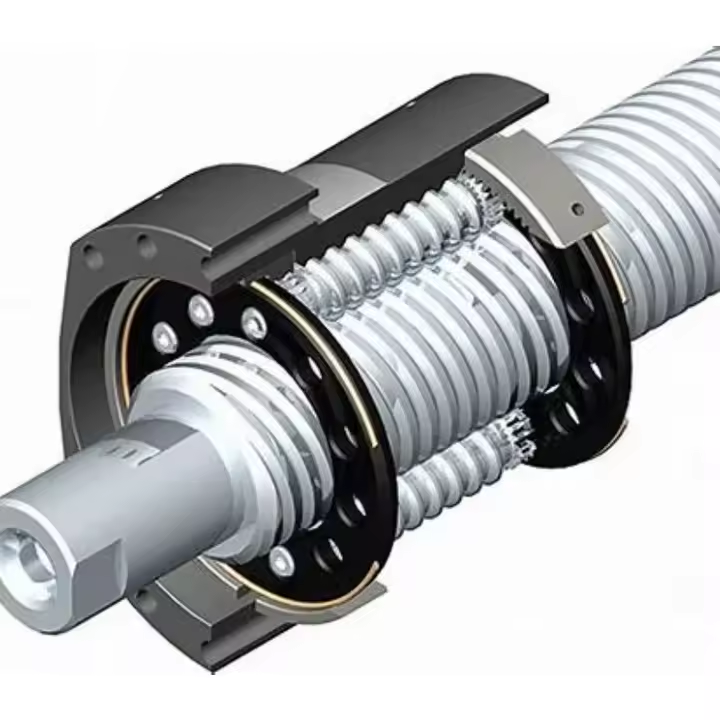
- scotty79AI that drew the diagram couldn't get it's neurons around how planetary screws in linear actuator should work.Here's an actual schematic: https://ae-pic-a1.aliexpress-media.com/kf/Sd3fe9841e4ed4871b...Why these screws are used instead of just threads? Because rolling friction is lower than sliding friction. You can use less or more of them trading friction for shock resistance.
- scotty79I really like the idea of using two series elastic actuators in parallel on the same joint. This way motors acting in opposite direction can pre-tension the springs making the leg stiffer or softer. And if a lot of strength is needed they can act in the same direction summing their forces.It should be fairly straightforward to control dynamically so you can use pretty much any motor and gearbox.
- ReptileManExcept we don't need 100% bipedal robots. Wheels are perfectly ok for majority of city work and factory floor.Put the robot on rollerskates break the wheels for the occasional stair.
- spwa4TLDR: we don't have the actuators required to make humanoid locomotion work reliably.Also: something every human actually kind of knows. You need to take impacts on muscles, not on mechanical connections. Even if we had the actuators required, you also need perfect control. The only way actuators can work this well is if they properly predict the impacts so that the power of the motor ("the magnetic field") can absorb nearly all the impact. If you try to take the impacts even on human bones (that are very solid and self-repairing) they will break surprisingly quickly.My opinion is that the need for high reduction is only because we can't have high voltage on the motors. If we either had very small distances between the magnets and electrical wires (think micrometers), or we have voltages in the 100s to 1000s of volts, we don't have to make this poisoned choice. (in a way, VERY small distances between magnets and wires is how human and animal muscles do it. But they go all the way down to sub-10 nanometers)
- Miles_Stone[flagged]