<- Back
Comments (19)
- st_goliathIf you have a few hours to kill, the Youtube Channel "Another Boring Topic" has a multi part series on the "rise and fall of the IBM PC". The comparatively short Part 1 is here: https://www.youtube.com/watch?v=Er8wcWsG7sEThe Channel has similar video series on OS/2, VisiCalc, Microsoft Excel and early Windows (far from completion). The videos are generally very detailed and well researched, often contrasting accounts from different source or even reaching out to people involved.The already slow pace of the channel has slowed down a lot. In an update video a while back, the author has announced that the background research for the IBM PC led down an unexpectedly deep rabbit hole and his script eventually spiraled into an unfinished book that will now probably turn into a two-parter itself.
- gumbyHaving lived through that time I find this article extremely accurate and focused on the important stuff.I didn’t pay much attention to the PC at that point (I was programming Lispms, Dorados and KL-20s) but it was impossible to ignore.
- tracker1In retrospect, I think IBM would have been much better off if it had done two things differently... Made the deal with MS such that any external sales had a minimal price with a kickback to IBM, and that IBM would license its BIOS directly to third party MFGs.If they'd have done that, much like MS, they'd have a piece of every PC sale, not just their own hardware.That said, I don't think IBM culture could ever have that level of foresight or for that matter hold back the greed to try to own the whole pie. Just watching what became of OS/2. By the time NT4 came out, it was pretty much over... NT4 was leaps and bounds nicer to work with than OS/2 had been, and the software much more plentiful.Not that MS was much better in terms of monopolistic tendencies, they managed to leverage their position both better, and in many ways have better overall offerings. Then again, MS today is a poor shadow itself of what it could have been had they not tried to start leveraging their own desktop customers for pennies on the dollar. Linux will erode their market share over time, and frankly, I'm surprised that MS doesn't have an AppImage/Flatpak version of MS Office for Linux that they license. They still have relatively nice tools, and though their online versions mostly work, it's not nearly as good and a lot of the integrations are still clunky.
- whobreNot bad, but I like this one better: https://arstechnica.com/gadgets/2017/06/ibm-pc-history-part-...And specifically for the IBM choosing Microsoft: https://nemanjatrifunovic.substack.com/p/why-ibm-turned-to-m...
- inguzI quite clearly remember this magazine issue from the time.A giant, god-like hand reaching out from the clouds. Tagline "THE JOLLY GIANT DELIVERS THE GOODS".https://www.computinghistory.org.uk/det/1706/Personal-Comput...
- zabzonkWhat happened to the little tramp with the walking stick? I had one of those sticks (as a biro) off an IBM salesperson, early to mid 80s, and IBM must have paid an ungodly amount to Chaplin for the IP.But I really did love the IBM PC. And very sad about Don Estridge and his wife - if he had joined Apple they might still be alive today.
- criddellI wish somebody sold a remake of the original PC case for modern hardware. It’s such a great design.
- TMWNNOne point I was not aware of is that Gates offered to put IBM in touch with SCP for SCP-DOS, but IBM turned down the offer because it preferred a single source!(It's understandable. Microsoft, even if tiny compared to IBM, was a real company with a real business model. SCP was just a couple of guys in one office.)
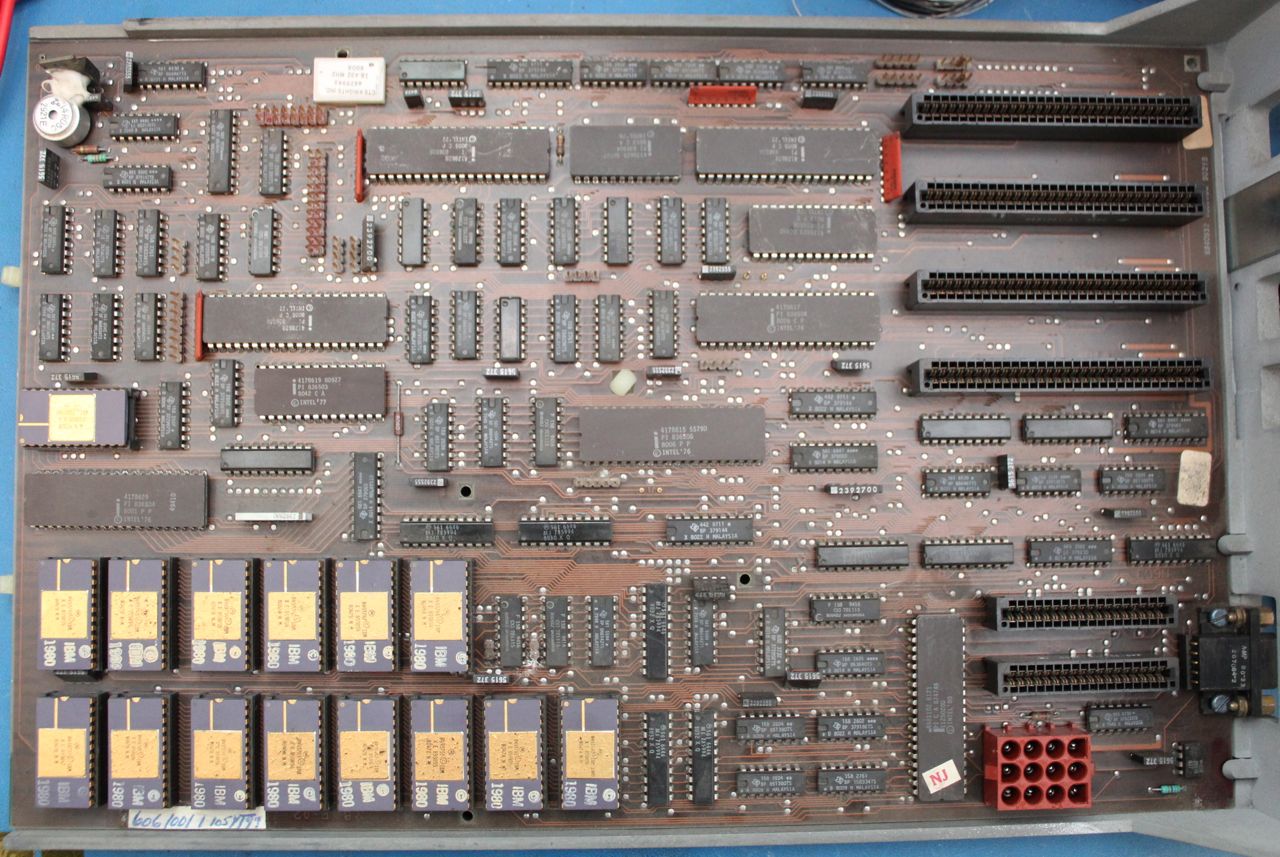
- dosman33TL;DR: I believe the Datamaster should be considered part of the lineage of the ATX standard today.The interesting thing I recently noticed about the Datamaster is that I believe this system's motherboard inadvertently (or deliberately) became the very first informal motherboard layout standard, a predecessor to the original IBM PC format. The Datamaster and PC are different architectures so it's not an architectural link, but it's clear that the same engineering group that designed the Datamaster's motherboard also had some amount of influence in the PC's motherboard layout. There's nothing magic about the Datamaster's layout, it's just very sensible: power in one corner, I/O slots near the rear edge, BIOS and RAM at the other end, CPU roughly in the middle of everything it has to talk to. But before the Datamaster, systems like the 5100 and System 36 used discrete boards that just plugged into a backplane with minimal logic on it. For the era of those systems that made sense, but those dense card connectors add cost and they add electrical noise to the system. A unified motherboard design was a true improvement in design that matched manufacturing improvements arriving in the late 1970's.Datamaster motherboard (those are not ISA or "PC bus" slots): https://www.nf6x.net/wp/wp-content/uploads/2014/09/IMG_3121....Similarly, there were loose standards like LPX in the 1990's which were never a formal design standard, but clearly every PC maker of that era was using the same logical riser-card design. Perhaps it was the same Taiwanese engineering firm doing the actual design work on the back end for everyone that generated LPX, or perhaps it was just working knowledge moving as individual engineers had success with various designs.
- jdw64I like the design, I like the content too. I wonder when I'll be able to make a homepage like this
- lprovenNot bad. I don't like its tone of approval, TBH.I much preferred the« raucous bazaar, teeming with variety. »I hate the way the PC« the IBM PC and its successors paved over all of that »I really did not like...« he strange boxes at the electronics store labeled “Amiga” and “Atari ST” (the last gasps of dying giants) »That is not merely unfair, it's wrong.It's a very American viewpoint. I only discovered in recent years that in the rest of the world, the Amiga and ST did much better than at home.I was a kid when this happened. The Mac launched when I was... 15 I think?To a rounding error, nobody owned PCs in the UK. They were extremely expensive business machines. Nobody owned Apple II either, and Macs were for the seriously rich.We used Sinclair and Oric and Acorn and other brands American writers have never even heard about. We aspired to Camputers and Elan and Memotech.Nobody _wanted_ office equipment. Would you offer a child a stapler to play with? That's how fun the PC was.Amigas were huge and very desirable and seen as a gift from the future -- see this article from 2 days ago:https://dfarq.homeip.net/amiga-1000-ten-years-ahead-of-its-t...If you couldn't afford an Amiga, then the ST was a worthy competitor.They were not some flop, some footnote of history. You can still buy new Amiga compatibles today from loads of vendors...https://www.apollo-computer.com/v4standalone.phphttps://www.a1200.com/index.php/the-a1200-ng/The ST OS became FOSS and there are multiple modern versions:https://emutos.sourceforge.io/https://gitlab.com/AndreasK/Atari-Mac-MagiC-SourcesAnd don't neglect the Acorn Archimedes which stomped on both.Its OS is FOSS now.https://www.riscosopen.org/content/Runs natively on Raspberry Pi. Other compatible new machines are being made and sold:https://shop.elesar.co.uk/index.php?route=product/product&pr...Sinclair's QL hardware still has compatible machines made today:https://www.specnext.com/sinclair_ql-qs/https://sinclairql.net/djw/q68/index.htmlThis stuff was nothing to be banished to a footnote, dusty unsold boxes with weird names or whatever.