<- Back
Comments (72)
- alexpotato> Every ARM reset was known, dated, and contractually inevitable from the moment of origination. Aggregate those reset schedules and you get the most damning exhibit of the era: the reset wall.One of my distinct memories from this era is watching CNBC where a guest said exactly the same thing.As the interview went on, he became more animated and used stronger language to the point of:"You don't get it, THEY ARE GOING TO BE PICKING PEOPLE OFF THE FLOOR when these ARM rates reset"I would guess this was right about 2006 which lines up with the article.
- awonghI get the structural comparison they are trying to make.But mortgages are not a frontier AI lab.They try to draw a comparison to the valuation of the real estate and the valuation of the hyper scalers in the markets.I would argue that the demand and valuation of a house is less elastic than AI. While a house’s value may continue to appreciate in the market there is an upper bound for the price of a house set by people’s income. We don’t know yet what the value of AI is. The underlying product, the model keeps improving and therefore increases its value. A house is still fundamentally a house a year later and doesn’t intrinsically appreciate in value.From gpt-3 to gpt-5.5 there’s been a massive change in the underlying value of the product and company in a way that simply doesn’t happen with a house. That’s where the analogy breaks down.
- EspressosaurusInteresting piece, I just wish the author had presented the data and their thesis instead of making Claude vomit out 20 pages of trash around it.
- jumanji493wow excellent piece. Gary Marcus had a long post about this article on his substack.scary stuff"And look at what this implies about OpenAI’s valuation as it moves toward an IPO:OpenAI’s equity - valued north of $850 billion - is functionally the junior tranche of a capital structure whose senior claims, the take-or-pay compute obligations, exceed any revenue path management itself has articulated.On those numbers, the equity is effectively underwater, and the market has not priced it that way because it still treats those obligations as service agreements rather than what they are economically: debt.Even if OpenAI can meet those obligations, OpenAI’s unaudited financial statements - as of March 31, 2026 - disclose $665 billion in non-cancellable compute commitments (management’s more recent plan runs to $750 billion). These commitments are take-or-pay in structure - which, as established above, is debt.Carry the net present value of those obligations as senior debt - roughly $450–500 billion, the same methodology rating agencies have used for decades to capitalize take-or-pay contracts as debt - and a company the market prices as debt-free carries a senior claim worth more than half its entire equity value."and the 2008 analog"Millions of subprime borrowers were, at that moment, paying the low introductory rate on a two-year adjustable rate mortgage - the 2/28 ARM. A low fixed-rate for two years, then the rate reset to a payment 30% to 50% higher. During those first two years the loan performed beautifully: the borrower paid, the servicer collected, and the bond paid its coupon. Nothing looked wrong because the whole complex - housing, mortgages, securitization - was sitting inside the teaser period.The AI boom has rebuilt this exact structure, and the market is once again underwriting the teaser.It has a reset wall of its own - a schedule of dated, contractual, non-negotiable payment shocks - hiding inside the trillions of dollars of compute contracts signed by OpenAI and other frontier labs since 2024."
- yoggies_broBecame obvious it was AI authored as I read, classic AI overstatement of parallels, lots of jargony words, its not X it is Y.
- qoezI always imagined they're doing that psychological experiment where they randomly give a rat food when they press a button. They get way more addicted than when it's a consistent amount. They can't get away with the optics of facebook-level gamification but this is some sort of loop hole.
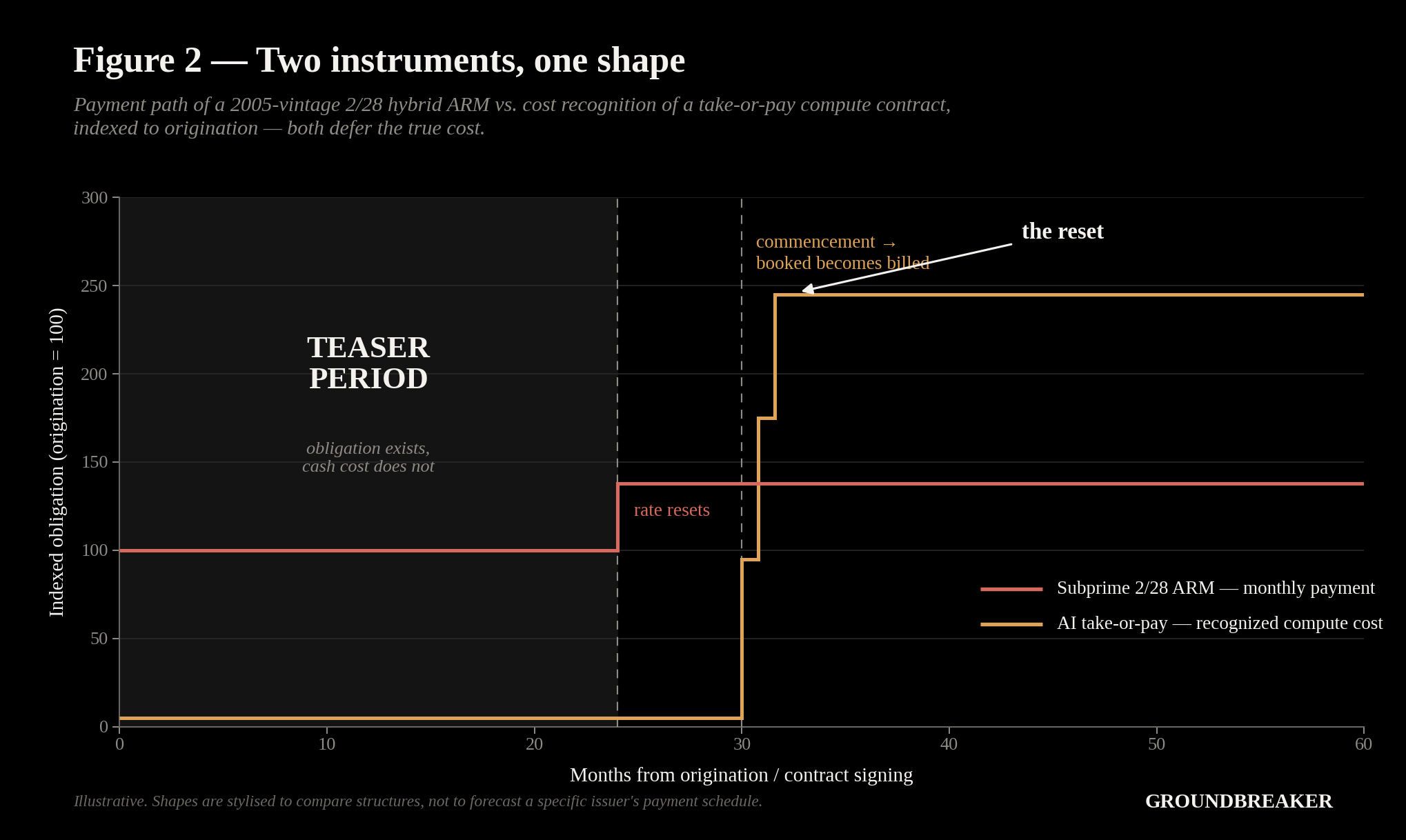
- alwaThis feels like Claude thought to me—assertions and comparisons that look impressive on the surface, but kind of make me scratch my head the more I think about them.I think what made me throw in the towel was “Figure 2 — Two Instruments, One Shape” [0]. That chart comparing when contracts reset. Weirdly consistent norms! [looks at the sourcing] Oh… it’s… not from data at all… it’s just notional…Is there anything here other than “the people financing the factory are betting that it’ll be able to sell what it makes once it’s built”?I mean… isn’t “an instrument that splits time in two” kind of… what capital financing is? And this risk is what earns investors their interest, and the rest of the financial system involves different ways for people to calibrate their bets on the risk materializing?Including derivative instruments that allow investors to smear out the point-in-time “cliffs” this writer is concerned about? If you think the revenue is never going to come, you can bet on that now. Or go into the distressed datacenter acquisition business to prepare! Conversely if Payment Day comes and you think they just need a couple more months, you can adjust the loan or make them a new loan to cover those first few months’ payments, etc., right? Since both parties stand to lose if it blows up completely, unless it’d be worth more to sell to somebody else?These are also not individual homeowners’ “investments.” The risk is coordinated, and it’s big, but we know that already, right? Yes we know the revenue, yes it’s different from the costs of paying down their capital investments, yes both are reported on the financial disclosures.How is the claim here any stronger than “all this depends on them actually being able to sell this crap once they get it built”?[0] https://substackcdn.com/image/fetch/$s_!-2DS!,f_auto,q_auto:...
- HavocIt’s an interesting comparison. The housing market is linked to the value of the house though which is subject to crashes in value without a corresponding drop in demand.With AI it comes down to whether the large companies orders and building of datacenters aligns with token demand. There is years worth of lag there so they kinda have to front load this by necessity
- anonundefined
- SynaesthesiaIMO there is overinvestment in compute and this will turn out to be a bubble.But all of the money was anyway just lying around doing nothing. An enormous amount of capital has been building since the 80's thanks to corporate profits. A small sector of the population is so rich they don't know what to do with their capital.
- NDlurkerSo, start selling risky assets for bonds and wait for the crash to buy back in to stocks?
- atleastoptimalSomeone who only knows finance trying to apply that logic to the singularity. There is no comparison. AI does not obey money, money obeys AI, or rather, the operating force of commodified intelligence will not just evaporate when inconvenient obligations for payment come around.Also it seems evident the article is largely AI written, which makes it even funnier.
- bradfaIt would be nice if the article cited the actual contracts the labs have signed so that others could also read them and draw their own conclusions (maybe it does and I got tired of the slop-like writing style too early?).Are the contracts actually take-or-pay-style? What are the terms? What are the amounts of compute and money involved for each future time period? What happens if the datacenter costs spiral upwards? What happens to the datacenter investment if the buyer goes bankrupt, goes public, or gets acquired (potentially by the datacenter owner)?I personally think the datacenter build-outs are going to generally be a big swing and a miss. The problem 1-2 years ago was making models good enough to be useful for a variety of tasks. Now we have that. The next problem is making the models efficient enough to run a profitable business. Recent Chinese lab model releases (because they're already constrained on compute resources) and OpenAI price cuts on Luna seem to indicate that this transition to chasing efficiency has already started.
- harshawSome other commentators said this was AI slop. I don't have enough expertise to say if it really is, but it sure has the "claudish" cadence of AI generated text that makes it hard to take it seriously. The authoritative and strong statements, the use of phrasing with colons and dashes, the use of bold, etc.
- tschellenbachThis post is just AI slop. The details of these contracts aren't disclosed as far as I know.You need to understand the contracts, the acceleration of demand, how the various inputs into supply scale (energy, chips, data centers) etc to say something sensible about this.
- hughw"The hidden mechanics reveals how the AI boom breaks, and when."I stopped there. I just resist reading slop.
- firmretentionSloppity slop.